Table of Contents
Global alliances are being rewritten in 2025 as emerging economies strengthen ties across Asia, Africa, and Latin America. Here’s how these shifts are reshaping the world’s balance of power.
Introduction
The world in 2025 looks very different from just a decade ago. Power is no longer concentrated in the hands of a few Western nations; instead, influence is diffusing across new economic blocs, regional alliances, and digital partnerships. From the expansion of BRICS to renewed G7 engagement, a new global balance of power is emerging — one that reflects changing priorities in trade, energy, and technology.
These shifts are not only economic or political; they signal the rise of a multipolar world order, where cooperation and competition coexist in complex ways.
The Rise of BRICS+ and Emerging Coalitions
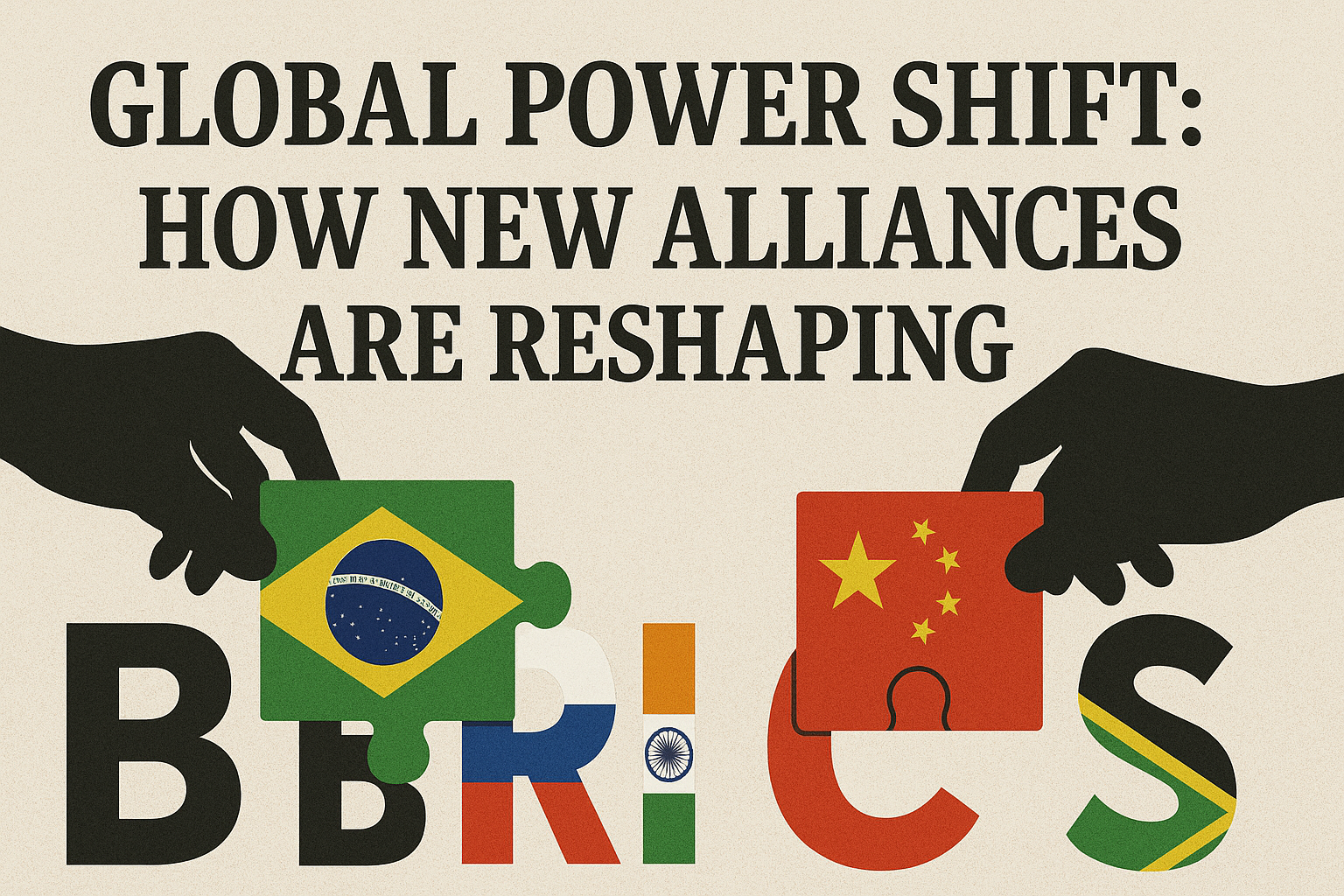
The expansion of BRICS (Brazil, Russia, India, China, South Africa) into BRICS+, including members like Saudi Arabia, Egypt, and the UAE, marks one of the most visible signs of this shift.
According to the International Monetary Fund (IMF), BRICS nations together now contribute over 36% of global GDP (PPP) — surpassing the G7’s combined share.
These nations are also coordinating on currency settlement systems, moving away from dollar dominance. The New Development Bank (NDB) has begun funding projects in local currencies, signaling long-term financial diversification.
Beyond BRICS, Asia-Pacific frameworks such as RCEP (Regional Comprehensive Economic Partnership) and the Shanghai Cooperation Organisation (SCO) are strengthening trade and security ties — giving the “Global South” a louder collective voice.
Western Response: G7, NATO, and Recalibration
The traditional power centers — primarily the G7 and NATO — are responding by doubling down on strategic cooperation.
In 2024, G7 leaders reaffirmed economic partnerships through clean-energy investment packages and AI-governance frameworks (G7 Hiroshima Leaders’ Communiqué, 2023).
NATO, once Euro-Atlantic focused, is also extending its reach. The NATO 2024 Strategic Concept recognizes China’s growing influence as a “systemic challenge” and encourages cooperation with Indo-Pacific democracies like Japan, South Korea, and Australia.
These adjustments reflect a recognition: the West’s dominance is no longer absolute, and security now depends on broader coalition networks.
India’s Balancing Role
Among emerging powers, India occupies a unique position. As a founding BRICS member and a key Quad (US, Japan, Australia, India) partner, India maintains diplomatic flexibility between East and West.
According to the Observer Research Foundation (ORF), India’s foreign policy emphasizes “multi-alignment” — engaging multiple partners simultaneously rather than adhering to traditional blocs.
India’s hosting of the G20 Summit (2023) showcased its bridging role: bringing together developed and developing nations on issues like digital infrastructure and climate finance. In 2025, India continues to push for Global South representation in multilateral institutions like the UN and IMF.
Tech, Energy, and Defense Realignments
Power shifts are no longer defined solely by military or GDP strength. The new battlegrounds are technology standards, energy security, and digital sovereignty.
- Technology: The competition over AI, 5G/6G, and semiconductors has led to new tech alliances — such as the EU–India Trade and Technology Council (TTC) and US–Japan semiconductor partnerships (European Commission).
- Energy: The transition from fossil fuels to renewables is redistributing energy influence. The International Energy Agency (IEA) notes that solar investments in Asia now outpace traditional oil and gas expansion in the Middle East.
- Defense: Regional defense pacts like AUKUS (Australia–UK–US) and Quad exercises in the Indo-Pacific signal security decentralization, countering both traditional and cyber threats.
Toward a Multipolar World
The term “multipolarity” — once an academic concept — is now a daily geopolitical reality.
No single country dominates every sphere. Instead, regional players influence localized outcomes: Turkey in West Asia, Brazil in Latin America, and Nigeria in Africa.
Analysts at the Council on Foreign Relations (CFR) argue that the next decade will be characterized by “competitive cooperation” — nations collaborating where interests align (climate, health, AI) but diverging sharply elsewhere (trade, defense, data).
This interconnected but contested landscape demands adaptive diplomacy and stronger global governance frameworks.
Challenges of the New Order
A multipolar world also brings risks:
- Fragmented technology standards (e.g., digital protectionism)
- Currency instability if parallel financial systems evolve too fast
- Regional conflicts escalating without strong mediation frameworks
The World Economic Forum (WEF) highlights geopolitical fragmentation as one of 2025’s top global risks — citing disrupted trade and weakened global cooperation.
Conclusion
The global power shift of 2025 isn’t a sudden upheaval but a gradual correction of balance — a world where influence mirrors diversity.
From economic coalitions to climate alliances, power today is distributed, not concentrated.
Nations that adapt — embracing strategic flexibility, technological collaboration, and inclusive diplomacy — will define the next decade’s global order.
For more such topics, see World